

About PCOR


Our Approach
We are transforming the way we approach restoration by shifting from a siloed status quo approach focused on individual habitats, focal species, or specific geographies to a more strategic and comprehensive approach that recognizes the ecological interactions within rocky reef and kelp forest ecosystems.

The PCOR initiative aims to:
- Create a restoration network for rocky reef and kelp forest habitats, and key species, across the state of California to leverage shared knowledge, resources, partnerships, and infrastructure to improve coordination of complementary restoration projects
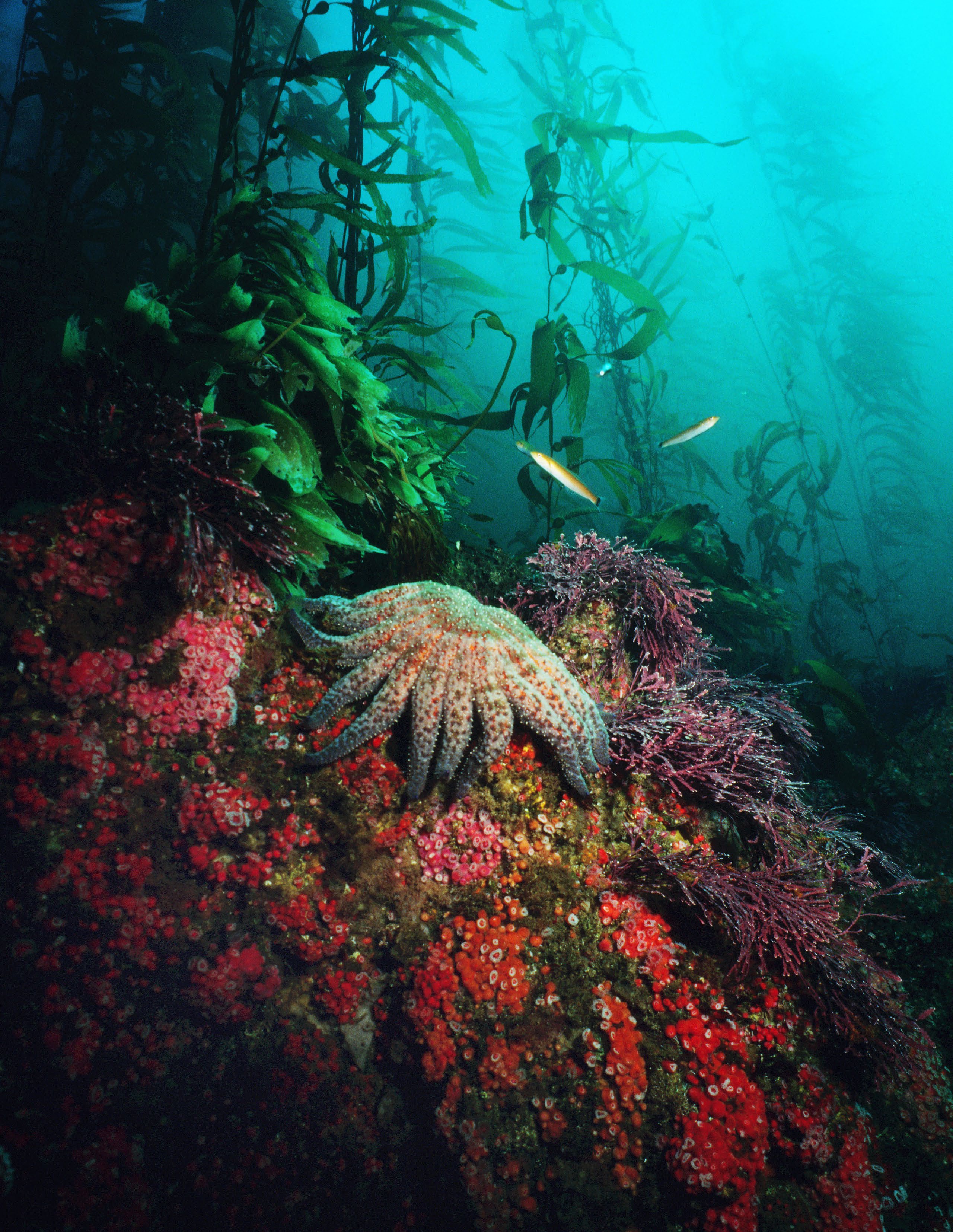
- Implement in-water restoration and infrastructure to scale recovery of endangered species by first focusing on key habitats and strongly interacting species: bull kelp forests, predatory sunflower sea stars, and endangered white abalone
- Pilot an innovative workforce development program that can support successful implementation of rocky reef ecosystem restoration projects
Delivering Transformative Impact
The PCOR Initiative aims to deliver transformative impact for rocky reef ecosystems and coastal communities through the recovery of key marine species and habitats, starting with the white abalone, sunflower sea star, and kelp forests, while also piloting an innovative workforce development program.

PCOR by the Numbers
-

2024
The PCOR Initiative Launched
-

20+
Partner Organizations and Growing
-

$18 M
NOAA Grant to Launch PCOR
Download
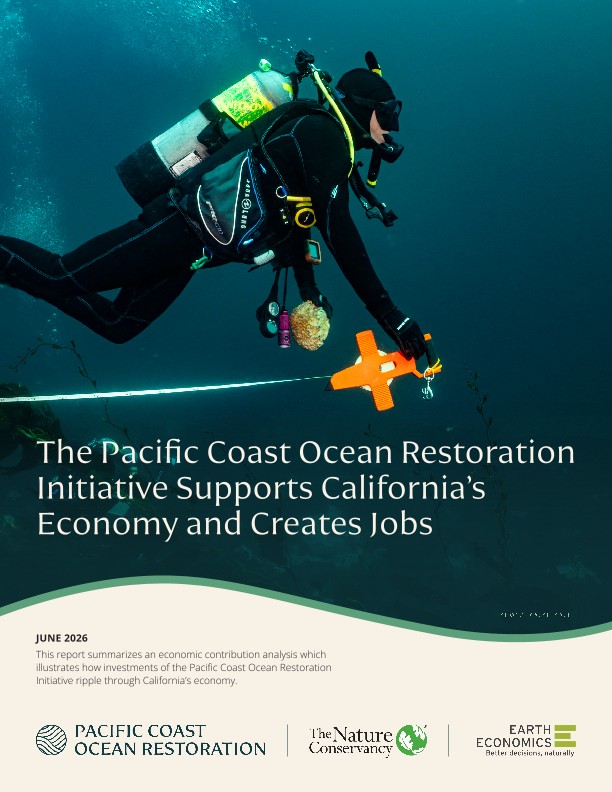
This report illustrates how PCOR investments ripple through California’s economy and deliver substantial and measurable returns across CA.
DownloadKey Findings from Economic Impact Report
- For every $1 invested, PCOR generates $1.87 in additional economic activity, reinforcing marine restoration as a smart and efficient investment, and not an environmental expense.
Ultimately, $17.5 million invested in marine restoration and species recovery in California generates $32.7 million in economic activity in California across 56 industries.
By investing in restoration, the Initiative ensures that California’s restoration economy can continue to grow, supporting resilient coastal communities, skilled jobs, and thriving marine ecosystems for decades to come.


Who We Are
Who We Are
-
The Nature Conservancy is a global conservation organization dedicated to conserving the lands and waters on which all life depends. Guided by science, we create innovative, on-the-ground solutions to our world’s toughest challenges so that nature and people can thrive together. Learn more at www.nature.org/california.
-
The National Oceanic and Atmospheric Administration (NOAA) is an American scientific agency within the United States Department of Commerce that focuses on the conditions of the oceans, major waterways, and the atmosphere. NOAA’s work touches the lives of every American, providing timely and trusted data and information about the environment to better understand and improve our lives.
-
The California Department of Fish and Wildlife (CDFW) is the State’s trustee agency for natural resources within the California Natural Resources Agency. CDFW manages California’s diverse fish, wildlife, and plant resources, and the habitats upon which they depend, for their ecological values and for their use and enjoyment by the public.
-
The California Fish and Game Commission was the first wildlife conservation agency in the United States, predating the U.S. Commission of Fish and Fisheries. The Fish and Game Commission sets regulations that are implemented and enforced by the California Department of Fish and Wildlife (CDFW), as well as provides biological data and expertise to inform the Commission’s decision-making process. Learn more at fgc.ca.gov.
-
The California Ocean Protection Council (OPC) is a Cabinet-level state body nested within the California Natural Resources Agency that works jointly with state and federal agencies, non-governmental organizations, California Native American tribes, and the public to ensure that California’s ocean and coastal ecosystems are healthy and resilient.
-
The University of California, Santa Barbara, is a leading research institution that also provides a comprehensive liberal arts learning experience. Teaching and research go hand-in-hand at UC Santa Barbara. Our students are full participants in an educational journey of discovery that stimulates independent thought, critical reasoning, and creativity. Our academic community of faculty, students, and staff is characterized by a culture of interdisciplinary collaboration that is responsive to the needs of our multicultural and global society. All of this takes place within a living and learning environment like no other, as we draw inspiration from the beauty and resources of our extraordinary location at the edge of the Pacific Ocean. Learn more at ucsb.edu.
-
The California Sea Urchin Commission was founded in 2004 and operates under state law to ensure a sustainable sea urchin resource and a reliable supply of quality seafood product for domestic consumption and export. Our mission is to ensure a reliable, sustainable supply of quality sea urchin products to consumers and enhance the performance of California’s sea urchin industry. Learn more at calurchin.org.
-
Greater Farallones Association (GFA) is the nonprofit partner to Greater Farallones and Cordell Bank National Marine Sanctuaries, federally-protected areas encompassing more than 4,000 square miles of open ocean and coastal waters off the California coast. Through high-impact programs rooted in science, GFA engages over 14,000 adults and youth a year in ocean conservation, collects critical data on wildlife, restores vital habitats, and helps communities adapt to the impacts of climate change through nature-based solutions. Learn more at farallones.org, @farallonesnews., and farallones.org/programs/kelp/
-
NOAA’s Greater Farallones and Cordell Bank National Marine Sanctuaries protect wildlife, habitats, and cultural resources within 4,481 square miles off the northern and central California NOAA’s National Marine Sanctuaries are our nation’s most significant natural and cultural marine areas and are a high priority for kelp ecosystem restoration efforts. Learn more at farallones.noaa.gov, cordellbank.noaa.gov, and farallones.noaa.gov/eco/kelp/.
-
Moss Landing Marine Laboratories (MLML) administers the Master of Science in marine science program for California State Universities in northern and central California, and is dedicated to the pursuit of excellence in both education and research. The mission of MLML is to provision the marine scientists of the future. This means that undergraduate and graduate students are provided with unparalleled access to faculty advisors and teachers, research facilities, and an incredible local marine environment. MLML is known for a hands-on, field-oriented approach which places our students, faculty, researchers and staff at the frontiers of marine science worldwide. Our primary goal is to provide students with the necessary skills and training to succeed in academia, governmental agencies, conservation, and management to serve societal needs involving marine issues. Learn more at mlml.sjsu.edu.
-
Reef Check is a non-profit organization leading citizen scientists to promote stewardship of sustainable reef communities worldwide. Trained citizen science divers collect data on kelp and coral reef health. This data is used by marine resource managers, scientists, and policymakers to make science-based decisions on ocean management and conservation. Reef Check’s Kelp Forest Monitoring Program has grown to be the largest scuba-based citizen science monitoring program operating in California, Oregon, Washington, and Baja California, Mexico. In addition to its monitoring program, Reef Check develops and implements ecologically sound and economically sustainable, community-based conservation and restoration approaches.
Learn more at reefcheck.org.
-
Sonoma State University is a public university in Northern California dedicated to excellence in teaching, research, and community engagement. Through its Biology Department, Sonoma State provides students with hands-on research opportunities in ecology, conservation, and environmental science while fostering collaboration between faculty, students, and community partners. Within the department, the Coastal Ecology and Conservation lab led by Dr. Brent Hughes conducts research on the resilience, conservation, and restoration of nearshore ecosystems, including kelp forests and estuaries. These efforts help advance scientific understanding and support the stewardship of natural resources. Learn more at sonoma.edu and hughesecology.com.
-
The non-profit Aquarium of the Pacific is dedicated to world-class conservation, outstanding animal welfare, and connecting people to nature through more than 12,000 animals and one hundred exhibits. In addition to its public education programs for all ages, the Aquarium is involved in numerous conservation efforts, including breeding endangered animals for release, rehabilitating rescued species, community science programs, and more. The Aquarium is home to the only sea turtle rehabilitation program in Greater Los Angeles. To make a donation to help support the Aquarium, please visit the donation webpage. To visit, reservations are required and can be made at aquariumofpacific.org or by calling (562) 590-3100.
-
The California Academy of Sciences is a renowned scientific and educational institution with a mission to regenerate the natural world through science, learning, and collaboration. Based in San Francisco’s Golden Gate Park, it is home to a world-class aquarium, planetarium, and natural history museum, as well as innovative programs in scientific research and environmental education—all under one living roof. Museum hours are 9:30 am – 5:00 pm Monday – Saturday, and 11:00 am – 5:00 pm on Sunday. Admission includes all exhibits, programs, and shows. For daily ticket prices, please visit www.calacademy.org or call (415) 379-8000 for more information.
-
Sunflower Star Laboratory is a community-based nonprofit that leads research and conservation to recover the sunflower star, building kelp forest resilience with our communities. Our organization is actively growing the critically-endangered sunflower star and other species in our conservation aquaculture facility in Moss Landing, CA, while conducting groundbreaking research and coordinating sunflower star recovery efforts across North America. Sunflower star recovery is an integral part of restoring California’s vanishing kelp forests, and Sunflower Star Laboratory’s experienced, interdisciplinary team leads groundbreaking work to make this imperative a reality. Head to www.sunflowerstarlab.org and @sunflowerstarlab for more information.
-
The Bay Foundation (TBF) is a 501(c)(3) non-profit environmental group founded in 1990 to restore and enhance Santa Monica Bay and local coastal waters. TBF is dedicated to implementing innovative, nature-based solutions along the Southern California coast to adapt to climate change, enhance ecosystems, and benefit communities. Since 1990, our team of science and communications experts has been advancing research, restoration, and stewardship. Learn more at santamonicabay.org.
-
The Cultured Abalone Farm is a long-time local of the Santa Barbara coast; it was established in 1989 and is located at the historic Rancho Dos Pueblos. Today, we raise red abalone from hatchery to the harvest, ranch purple sea urchins, and tumble culture red seaweed. In addition to serving premium seafood nationwide, we are involved with a number of conservation efforts, restoring abalone along the California coast and bringing balance back to our kelp forest ecosystems. Our mission is to restore abalone as an iconic California species, whether that is through seafood production or conservation restoration efforts.
-
Paua Marine Research Group is a woman-owned microbusiness created in 2016 to further restoration of marine habitats and species. Their primary projects include recovery of white abalone (Haliotis sorenseni) in southern California, enhancement of eelgrasses (Zostera spp.), particularly on the open coast, and surveys for imperiled rockfishes (Sebastes spp.) and sunflower stars (Pycnopodia helianthoides) in the Salish Sea. Their broad field and data capabilities have allowed them to integrate with multiple partners in each of these three work areas. Learn more at pauamarineresearch.com.
-
Learn more at city.fortbragg.com.
-
Mendocino College partners with a dynamic community of diverse students to help them achieve their educational goals. Informed by research, reflection, dialogue, equity, and anti-racist practices the College is committed to student success and achievement. Mendocino College embraces its role as an intellectual, economic, and cultural anchor for the region. Mendocino College instruction and services are an inclusive, caring, and accessible learning environment based on individualized student needs. Learn more at mendocino.edu.
-
Noyo Harbor is a small working harbor nestled in the redwoods along the Mendocino Coast. Steeped in tradition and a love for the ocean, Noyo Harbor is home to men and women who have devoted their lives to the ocean. Their days are determined by wind and tides, rather than clocks and commutes. Noyo Harbor is a reminder that fishing isn’t a lifestyle, it’s life where style is just an option. Learn more at noyoharbordistrict.org.


